
Sail under 24 bridges in Copenhagen Harbor

When you sail around Copenhagen Harbor, you pass a lot of bridges. Here's the list of the 24 bridges you can sail under in a GoBoat or another small boat. We tell you about their history, their size and whether they can open. Use the overview as inspiration for your next boat trip in the harbor.
Langebro
Langebro is one of the city's two car bridges and lies south of Knippelsbro. It's a double-leaf bascule bridge that has connected the city center with Islands Brygge on Amager since 1954. Back then it was called Kalvebodbro, because it crossed Kalveboderne. It later got the name Langebro (the long bridge) because it was quite a bit longer than Knippelsbro. The bridge was designed by Kaj Gottlob.
When the bridge was built, the southern part of the harbor was busy with coal ships carrying coal to the coal yards at Islands Brygge and the H.C. Ørsted power station. Today there's almost no industrial traffic in Sydhavnen.

⬌ 32 meters wide
⬍ 250 meters long
🔓 Can open
Lille Langebro
Lille Langebro, the little brother of Langebro, was built in 2019. It sits next to Langebro and connects Vester Voldgade by BLOX with Langebrogade. Lille Langebro is a bridge for bikes and pedestrians, built to take pressure off Langebro.
In fact, it sits where Langebro was from the late 1600s to the early 1900s. The new connection makes things better for the many people who walk and bike across every day, up to 10,500 a day. They no longer have to use Langebro. Besides helping its "big brother", the bridge brings more life to the areas around BLOX on Christians Brygge on one side and Kalvebod Brygge on the other.
Lille Langebro has a different shape than many of the city's other bridges. It doesn't run in a straight line but bends in a soft curve. For cyclists, that gives a slope that doesn't feel as steep.

⬌ 7 meters wide
⬍ 160 meters long
🔓 Can open
Bryggebroen
Bryggebroen runs between Islands Brygge and Havneholmen. When it opened, it was the first new bridge in Copenhagen in 50 years. It was finished in 2006 and is 190 meters long. In 2014 it was "extended" with Cykelslangen (the Bicycle Snake), which connects to Dybbølsbro. The bridge is for pedestrians and cyclists. Bryggebroen has become a popular place to hang love locks.

⬌ 5.5 meters wide
⬍ 190 meters long
🔒 Can't open
Knippelsbro
Knippelsbro runs between Slotsholmen and Christianshavn. The current bridge is the fifth one. The first version was built in 1618 to 1620, which makes it the oldest connection in Copenhagen Harbor. The name comes from Hans Knip, who was the bridge keeper around 1640. Knippelsbro is known for its two copper-clad bridge towers.
The bridge is for pedestrians, cyclists and cars. It's one of the city's two car bridges, and the other is Langebro. Together they connect central Copenhagen with Christianshavn and Amager. The bridge has two leaves that go up and down when ships need to pass.

⬌ 27 meters wide
⬍ 115 meters long
🔓 Can open
The Circle Bridge (Cirkelbroen)
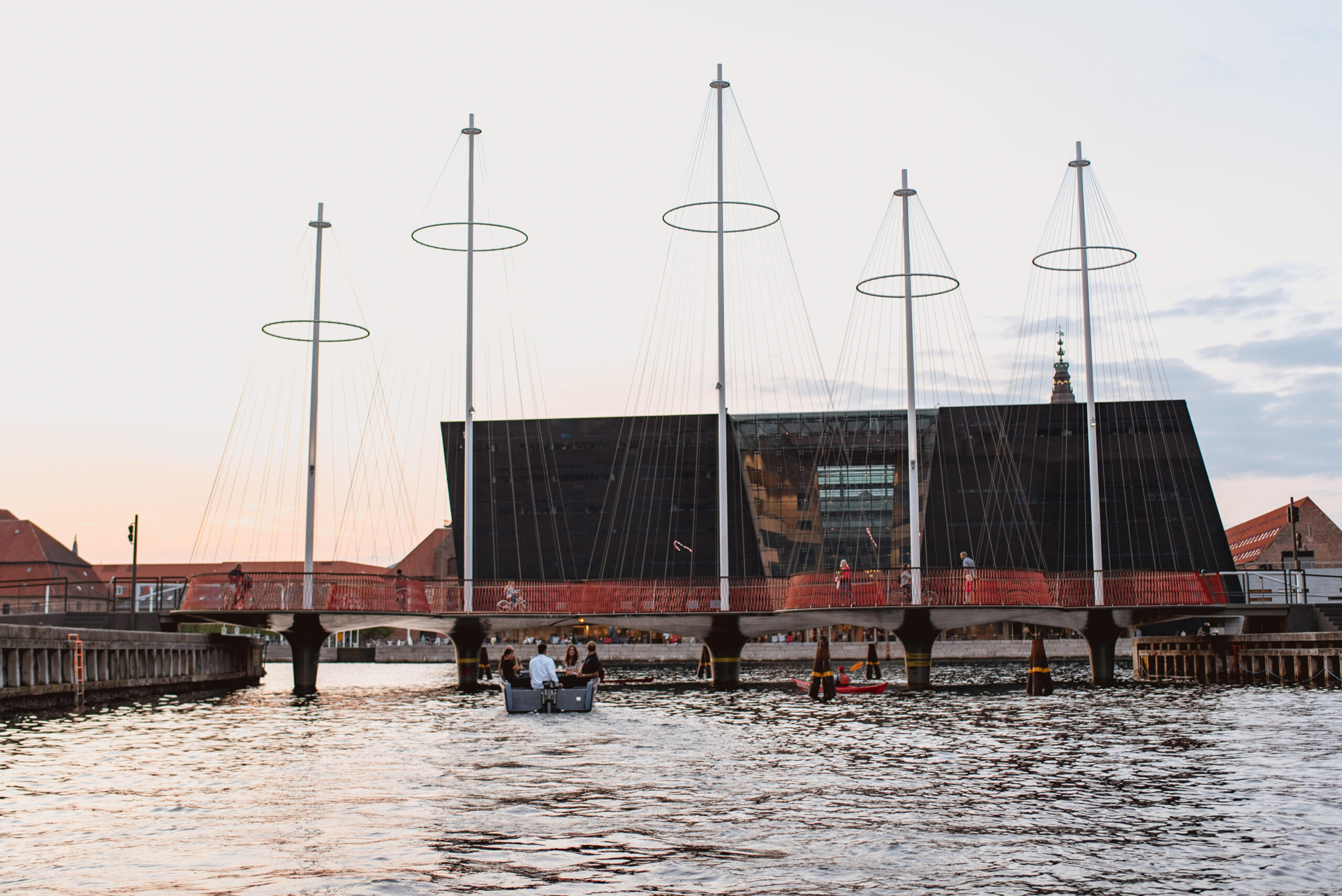
Cirkelbroen may be one of the city's most beautiful bridges. It connects Christiansbro with Applebys Plads where Christianshavns Kanal meets the harbor. It was designed by the Danish-Icelandic artist Olafur Eliasson and opened in 2015.
Olafur Eliasson designed it as a swing bridge inspired by sailing ships, with five offset circular platforms in different
sizes. A mast rises from the middle of each circle. The idea was, and still is, to get people talking about what a lively city space can be. The bridge isn't only meant to
get you from one place to another. It's also meant to tell a story about what goes on behind the waterfront, the closeness you find along and on the canals in Christianshavn.
⬌ 5 to 9 meters wide
⬍ 38 meters long
🔓 Can open
Inderhavnsbroen (the Kissing Bridge)
In 2016, Inderhavnsbroen, which connects Nyhavn with the old Greenland trading post in Christianshavn, was finally finished. The 180-meter bridge is for bikes and pedestrians, and it's also a sliding bridge that opens for boats.
When the two 250-ton steel sections open, they leave a 50-meter gap. When they meet again, it looks like a kiss, which is where the nickname the Kissing Bridge comes from. The design was inspired by one of Michelangelo's most famous works in the Sistine Chapel, showing two hands, God and the first human, whose index fingers almost touch. The architect, Cezary Bednarski, had the painting in mind when he designed how the two sections meet in the middle.
When Inderhavnsbroen was finished, the Harbor Circle was complete. It's a route for walkers and cyclists that lets you take different trips along and around the harbor.
⬌ 14 meters wide
⬍ 180 meters long
🔓 Can open
Trangravsbroen
Trangravsbroen connects Christianshavn and Arsenaløen, where Christianshavns Kanal runs into Trangraven. The bridge was a gift to Copenhagen from the A.P. Møller Foundation (A.P. Møller and Chastine Mc-Kinney Møller Foundation).
The bridge looks different from most of the city's other bridges, because it has three arms. It's made up of two bridges for pedestrians and cyclists that connect Christianshavn with Arsenaløen, and Arsenaløen with Holmen.
Trangravsbroen is part of a larger plan to connect Nyhavn with Holmen. Its look is minimalist, and when the bridge is open, it can look a bit like a butterfly. It opens at set times, which you can see on the City of Copenhagen website (in Danish).

⬌ 5.4 meters wide
⬍ 56 meters long
🔓 Can open
Proviantbroen
The minimalist Proviantbroen branches off from Trangravsbroen, and together they make it easy to get from the city center to Holmen and back. The bridge was finished in 2014. It's a narrow bike bridge that runs parallel to Frederiksholmsbroen and connects Arsenaløen with Holmen. Proviantbroen has a "shark fin" running down its length that separates cyclists from pedestrians.
Inderhavnsbroen, Trangravsbroen and Proviantbroen are all part of a larger plan to connect Holmen with the city center.

⬌ 15 meters wide
⬍ 26.4 meters long
🔓 Can open
Frederiksholmsbroen
Frederiksholm and Arsenaløen on Holmen are connected by Frederiksholmsbroen, which can open, and is part of Danneskiold-Samsøes Allé. The bridge makes it easy for the many visitors from central Copenhagen, Christianshavn and Amager to get to Refshaleøen. Refshaleøen is home to the popular food market Reffen, which has many thousands of visitors every year. There are also other popular places like La Banchina, Lille Bakery, Copenhagen Contemporary, Amass, a climbing center, CopenHill and many more, which make a trip to Refshaleøen well worth it. The bridge is clearly an important link for both Copenhageners and tourists.

⬌ 10 meters wide
⬍ 16.9 meters long
🔓 Can open
Nyholmsbroen
Nyholmsbroen is one of the smaller bridges in Copenhagen Harbor. With Tømmergraven on one side and Maskingraven on the other, it connects Danneskiold-Samsøes Allé with Kongebrovej. The bridge takes you from Holmen over to the area where the popular restaurant Noma is.
Read more about the rules in Copenhagen Harbor
Nyholmsbroen is open to pedestrians, cyclists and cars. Like Frederiksholmsbroen, it's an important part of the infrastructure that gives easy access to Refshaleøen.

⬌ 4.1 meters wide
⬍ 15.5 meters long
🔒 Can't open
Teglværksbroen
Teglværksbroen is in the southern part of the harbor, down by the canal district at Sluseholmen. It's a bascule bridge that connects Sluseholmen with Teglholmen. Teglværksbroen is for cars, bikes and pedestrians, and it can open when sailboats need to get into Teglværkshavnen. The bridge has made a big difference to getting around the southern part of Copenhagen Harbor, especially for people on foot and on bikes.
About 1,800 people live in Sluseholmen, and the bridge gives them an easy way across to Teglholmen.

⬌ 20 meters wide
⬍ 97 meters long
🔓 Can open
Bryghusbroen
Bryghusbroen is a bascule bridge from 1935 that crosses one end of Frederiksholms Kanal on Christians Brygge, right by BLOX. When it was built, it also carried the railway tracks of Copenhagen's harbor railway across the canal. The tracks were removed in 1972.
Bryghusbroen is one of Copenhagen's smaller bridges, but it still carries boats, pedestrians, cyclists and cars.
The bridge opens four times a year, but only for maintenance. On a normal day, only small boats like private motorboats and rental boats sail under it.

⬌ 8 meters wide
⬍ 32 meters long
🔓 Can open
Footbridge over Frederiksholms Kanal
In 2016, a temporary footbridge was built on the waterfront by Frederiksholms Kanal. It was meant to make it easier for pedestrians to cross the canal while BLOX was being built. The bridge runs from the southern corner of Christian IV's brewhouse to Bryghusgade. Because it was only meant to be temporary, a crane can easily lift it and move it.
The bridge never got a name, since it was supposed to be there for a much shorter time than it has been. Nobody knows yet whether it will stay or be removed as first planned.

⬌ 3.5 meters wide
⬍ 16.9 meters long
🔒 Can't open
Prinsens Bro
The first Prinsens Bro was built in 1682. It's the first bridge at the entrance to Frederiksholms Kanal, close to Christiansborg. A new bridge was built in 1926 and lasted until 2017, when it was renovated. The 1926 bridge turned out to be in too poor shape to save, so only parts of it were kept and the rest was replaced. Today the bridge, which runs from Tøjhusgade on Slotsholmen to Ny Kongensgade, is in good shape.
The new Prinsens Bro combines parts of the old bridge with modern improvements. The original piers and lampposts were reused, while the deck was replaced. The bridge sits in a central spot close to Christiansborg.

⬌ 11.5 meters wide
⬍ 28.8 meters long
🔒 Can't open
Marmorbroen
Marmorbroen crosses Frederiksholms Kanal and connects the riding grounds at Christiansborg Palace with Ny Vestergade. It's called the Marble Bridge because its sidewalks are paved with Norwegian marble, while the bridge itself is clad in sandstone.
Nicolai Eigtved designed the bridge. It was first meant to be a drawbridge, but Eigtved wanted it to be a grand entrance to the palace instead. He also designed the two pavilions on either side of the gateway.

⬌ 16 meters wide
⬍ 11 meters long
🔒 Can't open
Stormbroen
The small arch bridge Stormbroen connects Stormgade with Slotsholmen. It got its name after 1659, when the Swedish army stormed Copenhagen right where Stormbroen is today. The city ramparts were there back then.
The bridge started out as a kind of emergency exit from Slotsholmen, a secret passage. The current bridge is from 1918 and was designed by the architect Martin Nyrop.

⬌ 23.7 meters wide
⬍ 25 meters long
🔒 Can't open
Højbro
In the 1700s there was a ferry from Højbro to Amager, and later the bridge we know today as Højbro was built there. Højbro is an arch bridge that connects Højbro Plads with Slotsholmen.
The current Højbro was designed by Vilhelm Dahlerup and built in 1878. Dahlerup also designed Holmens Bro and Børsbroen, but Højbro is the only one of his first versions still standing. The other two have since been replaced. In the 1960s, the bridge was widened to the width it has today.
In 1992, a group of bronze sculptures showing the Danish folk ballad Agnete and the Merman was placed on the bottom of Slotsholmskanalen by Højbro. The sculptures were made by Suste Bonnén.

⬌ 19 meters wide
⬍ 24 meters long
🔒 Can't open
Holmens Bro
Holmens Bro crosses the western part of Holmens Kanal between Slotsholmen and Gammelholm. It's a granite arch bridge. The current bridge was built in 1951. The original was from 1878 and was designed by Vilhelm Dahlerup.
Holmens Bro sits right in the heart of Copenhagen, with Holmen Church on one side and Christiansborg Palace on the other.

⬌ 25.5 meters wide
⬍ 18.4 meters long
🔒 Can't open
Børsbroen
Børsbroen runs from Havnegade to the junction at Børsgade and is named after Børsen, the old stock exchange right next to it. The bridge you see today is from 1933 and replaced the original from 1880. Like Højbro and the original Børsbroen, the new one was also designed by Vilhelm Dahlerup. It was built to carry the tracks of Copenhagen's harbor railway across Slotsholmskanalen.

⬌ 5.4 meters wide
⬍ 34.2 meters long
🔒 Can't open
Christian IV's Bro
Christian IV's Bro was built in 1961 to lead traffic away from Christians Brygge. It made it possible to route traffic along the water from Christians Brygge, under Knippelsbro and up Niels Juels Gade toward Kongens Nytorv. In 2015, the top and underside of the bridge were renovated, the road was renewed, and a new sidewalk and bike lane were added.

⬌ 27.4 meters wide
⬍ 115 meters long
🔒 Can't open
Børnehusbroen
Børnehusbroen carries Torvegade across Christianshavns Kanal. It was first called the Red Bridge and was built in the 1600s. Back then it was very narrow and fragile, so it was repaired in 1727. It was still too narrow for the growing traffic of horse-drawn carriages.
The current bridge is from the 1930s, when Torvegade was widened to its present width. The name refers to the "Børnehuset", a home for unruly, disobedient and orphaned children, built in 1662 where the Lagkagehuset bakery now stands on Christianshavns Torv.

⬌ 34 meters wide
⬍ 24.5 meters long
🔒 Can't open
Alfred Nobels Bro
The new Alfred Nobels Bro opened in 2018. It connects the new neighborhoods of Enghave Brygge and Teglholmen in Sydhavnen and crosses the canal to Frederiksholmsløbet. The bridge has a bike lane, a sidewalk and a road.
Alfred Nobels Bro isn't just meant to get you from one point to another. Its design invites people to stop and hang out. On the west side there's a 70-meter sculptural bench with a view over Frederiksholmsløbet, clad in mahogany logs. At 70 meters, it's the longest bridge in the southern part of Copenhagen.
The bridge was named to match the street names on Enghave Brygge, where every street is named after a winner of the Nobel Peace Prize.

⬌ 13 to 18 meters wide
⬍ 70 meters long
🔒 Can't open
Snorrebro
Snorrebro crosses Sankt Annæ Gade. The name goes all the way back to the first bridge built here. Back then, a "snorre", a kind of cross-shaped barrier, meant only pedestrians could cross. That bridge was opened with counterweights, which the bridge today doesn't have. The current Snorrebro was built in 1924.

⬌ 11.9 meters wide
⬍ 16.7 meters long
🔒 Can't open
Belvederebroen
In Sydhavnen you'll find the unusual Belvederebroen. This bridge for cyclists and pedestrians connects Frederiks Brygge and Enghave Brygge.
It looks very different from most of the city's other bridges, because its design was inspired by origami. The bridge is made of many folded red steel plates. The plates give
the bridge its strength and make it look almost like it's floating. The surface is covered with rubber, which absorbs noise from people passing by. The bridge looks calm and elegant in an otherwise gray and rough area.
Want to see lots of the bridges on one trip? Rent a GoBoat Classic and sail yourself, since it fits under all the bridges in the harbor. Or join GoBoat Harbor Tours or a private trip with your own captain on GoBoat Cruise. The covered GoBoat Pod stays in the main harbor channel, because some of the bridges are too low for it.

⬌ 5 meters wide
⬍ 21 meters long
🔒 Can't open
Frequently asked questions
Can you sail under the bridges in Nyhavn?
No, you can't sail into Nyhavn or under Nyhavnsbroen in a GoBoat.
How do you get a bridge opened?
If you want a bridge opened outside the regular opening hours, you need to book it in advance. You can read more about bridge openings on the City of Copenhagen website (in Danish).
How much does it cost to have a bridge opened?
Sailing through during regular opening hours is free, but outside opening hours it costs DKK 1,250 per bridge. You can read more about prices and opening hours on the City of Copenhagen website.
Can all types of boats sail under the bridges?
Several of the bridges in Copenhagen's harbor and canals are very low, so only small boats can get under them. The water level also makes a big difference to how much room there is between the water and the underside of the bridge. You can sail under all the bridges in a GoBoat.
How fast can you sail under the bridges?
The same speed limits apply under the bridges as everywhere else. In general, it's 6 knots in the main harbor channel and 4 knots in the canals.
Related Articles


